









The hidden voices, happy accidents and surprising stories behind 1993’s biggest hits
The hidden voices, happy accidents and surprising stories behind 1993’s biggest hits
The hidden voices, happy accidents and surprising stories behind 1993’s biggest hits
 Gary Oberholzer
The hidden voices, happy accidents and surprising stories behind 1993's biggest hits
Some songs become hits because everything goes according to plan. Others owe their success to a lucky accident, an unexpected remix or a second chance years after their original release. 1993 was full of those surprises, producing a soundtrack of unforgettable dance anthems, soulful ballads and pop classics — many with stories almost as remarkable as the music itself.
It’s the featured year on this week’s HOT Classic Countdown with Steve Bishop, taking place every Sunday from 12 to 3pm on HOT 102.7FM.
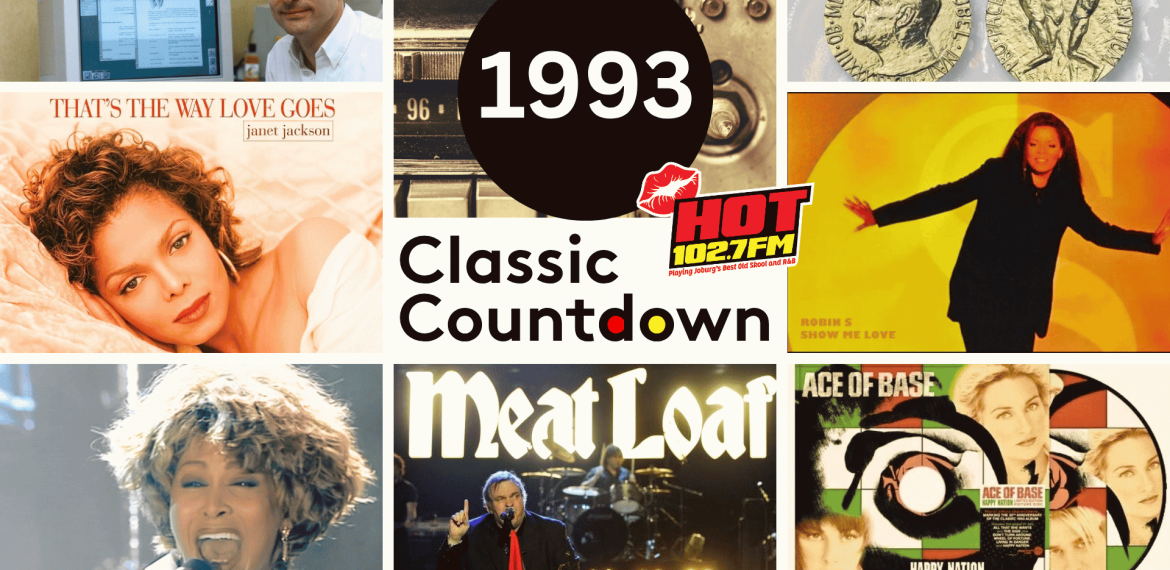
Take Robin S and “Show Me Love”, one of the defining dance records of the decade. Originally released in 1990, it attracted little attention until Swedish producer StoneBridge was asked to remix it. His first attempt was rejected, so he started again. While experimenting with his Korg M1 synthesiser, he accidentally switched from a bass sound to an organ preset.
That unmistakable, pulsating riff was born, helping establish a sound that would influence house music for decades.
Another extraordinary musical transformation came courtesy of SWV. Their “Right Here (Human Nature Remix)” incorporated Michael Jackson’s 1982 classic “Human Nature”, creating one of the most memorable R&B records of 1993.
Did You Know?
Listen carefully to the vocal chant in SWV’s “Right Here” and you’ll hear a young Pharrell Williams! Long before “Happy”, his collaborations with Daft Punk or his phenomenal production career, Pharrell was already making his voice heard on a major international hit.
But perhaps the most meaningful musical story of 1993 belongs to Soul Asylum.
The band’s haunting “Runaway Train” was accompanied by a music video featuring photographs of actual missing children, alongside information intended to help locate them. Different versions were produced for different countries, and the campaign contributed to several children being reunited with their families. It remains an extraordinary example of popular music making a difference beyond the charts.
Meanwhile, some familiar hits were enjoying an unexpected second life.
Meanwhile, some familiar hits were enjoying an unexpected second life.
Inner Circle’s “Bad Boys” had originally appeared in 1987, but its use as the theme to the American television series Cops helped propel it into the US Top 10 in 1993. It’s a perfect example of how television could transform a relatively obscure recording into a global favourite.
The Pet Shop Boys also breathed new life into an older song with their magnificent interpretation of the Village People’s “Go West”.
What sounds like an uplifting celebration carries a surprisingly poignant undertone. Chris Lowe explained that the duo were attracted to the contrast between the song’s idealistic lyrics and Neil Tennant’s more melancholy delivery. Their version became one of the defining pop anthems of the year.
And music was making its presence felt on the big screen.
Tina Turner’s powerful “I Don’t Wanna Fight” accompanied the release of What’s Love Got to Do with It, the biographical film depicting her turbulent life and extraordinary career. The accompanying soundtrack introduced new recordings alongside fresh versions of songs from her earlier years.
Michael Jackson’s stirring “Will You Be There” became closely associated with the family adventure Free Willy, while Peabo Bryson and Regina Belle’s “A Whole New World” continued the extraordinary musical success of Disney’s Aladdin.
Back in South Africa, the year unfolded against the backdrop of political uncertainty and growing hope for a democratic future.
The local music scene reflected the country’s diversity and creativity. Johnny Clegg’s deeply moving “The Crossing”, written in memory of Dudu Zulu, remains one of his most poignant recordings. Mango Groove’s “Nice to See You” showcased the band’s unmistakable fusion of African musical influences and pop, while Wendy Oldfield’s “Miracle” brought her distinctive voice to the airwaves.
And Vicky Sampson’s “African Dream”, which would subsequently become closely associated with the country’s new democratic identity, remains an enduring expression of hope and possibility.
Elsewhere, the soundtrack of 1993 was gloriously varied. Haddaway had everyone asking “What Is Love?”, Janet Jackson delivered the seductive grooves of “That’s the Way Love Goes”, and Meat Loaf returned with one of the most extravagant love songs ever recorded.
There were massive singalong moments from Bryan Adams, Mariah Carey and Billy Joel, while Ace of Base, Shaggy and Snow ensured that dancefloors and car radios were never short of irresistible hooks.
Outside the recording studio, Jurassic Park was transforming cinema, the Pentium processor was taking personal computing forward, and South Africa was preparing for a momentous political transition.
But through all the changes, it was the music that provided the memories.
And as these stories reveal, sometimes the most interesting thing about a song isn’t what you hear — it’s the story behind how it came to be.
Join Steve Bishop this Sunday for 30 countdown songs, homegrown favourites and the stories that take us back to 1981. Which chorus will bring your memories rushing back?
More Posts for Show: Classic Countdown with Steve Bishop