








1998: The year we fell for Titanic, searched with Google and learned to Believe
1998: The year we fell for Titanic, searched with Google and learned to Believe
1998: The year we fell for Titanic, searched with Google and learned to Believe
 Gary Oberholzer
1998: The year we fell for Titanic, searched with Google and learned to Believe
There are some years that feel like a bridge between two eras – and 1998 was one of them. The internet was beginning to change everyday life, the world was preparing for a new millennium, Titanic was seemingly everywhere, and pop music was shifting from the sounds of the ’90s towards something altogether more futuristic.
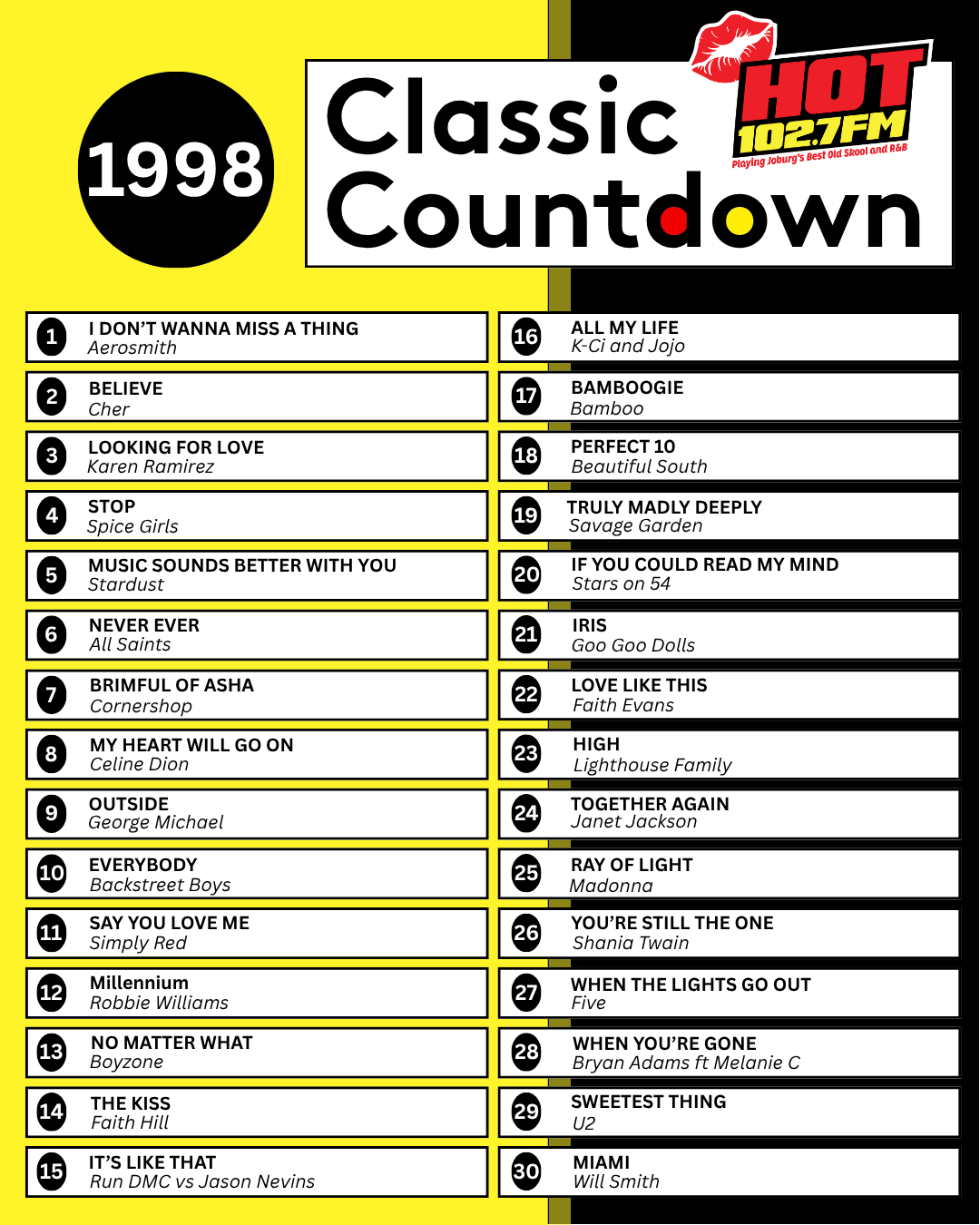
It’s the featured year on this week’s HOT Classic Countdown with Steve Bishop, taking place every Sunday from 12 to 3pm on HOT 102.7FM.
And what a soundtrack 1998 produced. Madonna reinvented herself yet again with Ray of Light, working with producer William Orbit to create an electronic sound that felt perfectly suited to a rapidly changing world. The album became one of the defining releases of her career, earning six Grammy nominations.
Elsewhere, Aerosmith delivered the enormous I Don’t Want to Miss a Thing, Goo Goo Dolls gave us Iris, George Michael turned heads with Outside, and Will Smith made Miami sound like the only place anybody needed to be.
Then there was Titanic. James Cameron’s epic had arrived in cinemas at the end of 1997, but 1998 was the year it became an unstoppable cultural phenomenon. In March it collected 11 Academy Awards, equalling the record for the most Oscars won by a single film. Its musical calling card, Celine Dion’s My Heart Will Go On, was similarly unavoidable – and it forms part of this week’s Classic Countdown.
Technology was moving just as dramatically. In September, Larry Page and Sergey Brin formally founded a little company called Google. The idea that “Google” would eventually become a verb – and that billions of people would carry access to it around in their pockets – would have sounded extraordinary in 1998.
The year also saw humanity begin building something remarkable above the Earth. On 20 November, Zarya, the first component of the International Space Station, was launched. Two weeks later it was joined in orbit by the American Unity module, beginning the assembly of the enormous laboratory that would eventually become a permanent human presence in space.
Back home, South Africa was still navigating the enormous changes of its young democracy. Nelson Mandela turned 80 in July, during what would be his final full year as president. Then, in October, Archbishop Desmond Tutu formally handed Mandela the Truth and Reconciliation Commission’s five-volume, approximately 3,500-page final report – another significant moment in the country’s attempt to confront its apartheid past.
South African music had its own stories to tell, too. This week’s selection includes homegrown names such as Doctor Victor, Watershed, Tree63, Naked and Egyptian Nursery – a reminder that while international pop dominated radio, local musicians were creating their own soundtrack to a country reinventing itself.
Did You Know?
One of 1998’s great dancefloor anthems came from a group that released just one song. Stardust – featuring Thomas Bangalter of Daft Punk, producer Alan Braxe and singer Benjamin Diamond – created Music Sounds Better With You, built around a sample from Chaka Khan’s Fate. The track became an international hit, and the music industry understandably wanted more. But Stardust never released another single or an album.
Most remarkably, Bangalter reportedly turned down a $3 million offer from Virgin Records to make a Stardust album. They made one song, created a dance classic – and walked away.
From My Heart Will Go On to Believe, from Mandela at 80 to the first pieces of the International Space Station, 1998 was simultaneously saying goodbye to one century and giving us tantalising glimpses of the next.
And this Sunday, Steve Bishop turns the clock back to hear what it actually sounded like.
More Posts for Show: Classic Countdown with Steve Bishop